
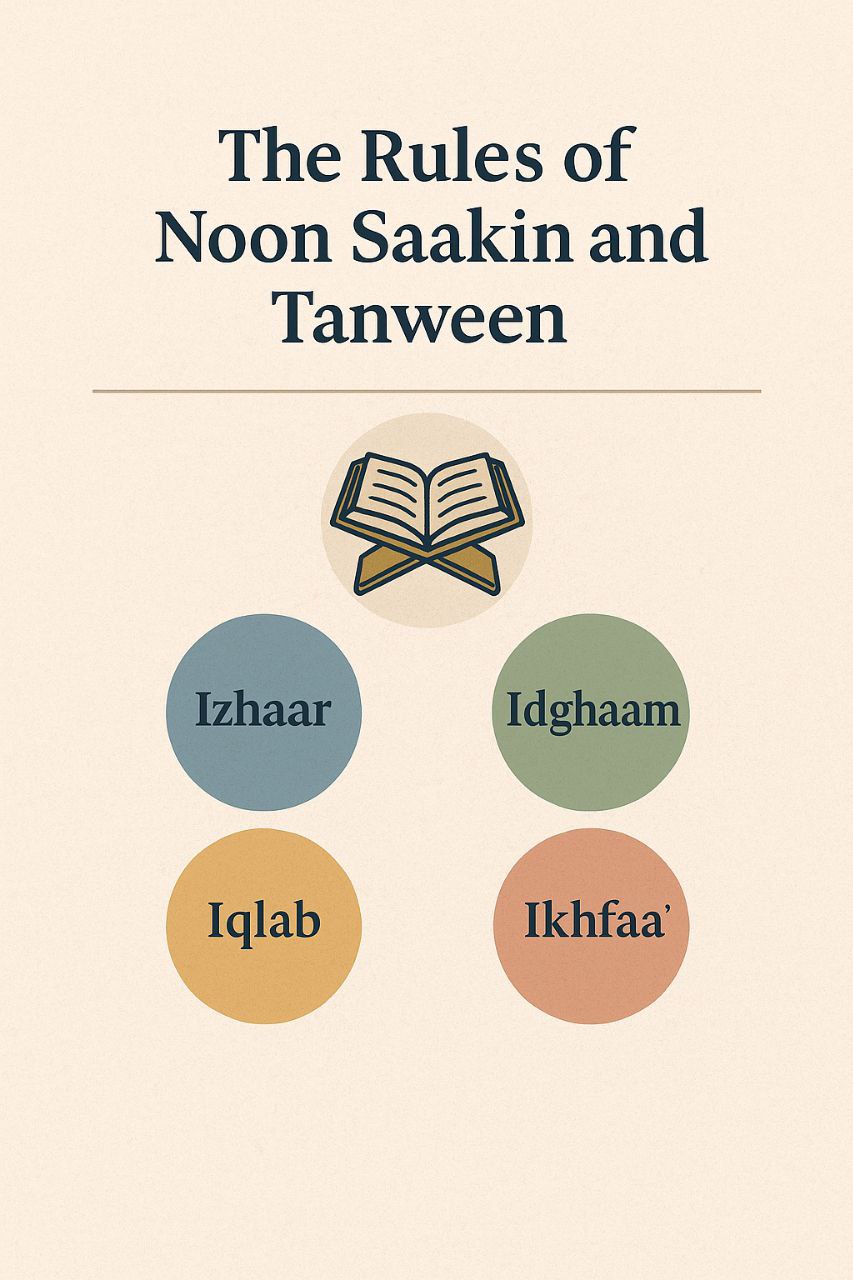
The Rules of Noon Saakin and Tanween in Tajweed
Mastering Tajweed is essential for accurate Quran recitation, and one of the core topics
every student must understand is the ruling of Noon Saakin (ن) and Tanween ( ً ٍ ٌ ). These rules help ensure
your recitation is both correct and beautiful. In this article, we explain the four rules
of Noon Saakin and Tanween with examples, designed especially for English-speaking learners.
What is Noon Saakin and Tanween?
Noon Saakin is the Arabic letter “ن” with a sukoon (نْ), and Tanween refers to the double vowel sounds at
the end of nouns ( ً ٍ ٌ ). These sounds are treated similarly in Tajweed because
they are both followed by one of the 28 Arabic letters, which affects how they are pronounced.
The 4 Rules of Noon Saakin and Tanween
1. Izhaar (Clear Pronunciation)
When Noon Saakin or Tanween is followed by one of
the six throat letters (ء، هـ، ع، ح، غ، خ), we pronounce it clearly without nasalization or merging.
Example: من آمن (min aamana) – the “n” is clearly heard.
If followed by any of these six letters (ي، ر، م، ل، و، ن), the Noon or Tanween is merged
with the following letter. It can happen with or without nasal sound (ghunnah).
Example: من يعمل (may-ya‘mal) – the “n” merges into the “ya”.
When followed by the letter ب (ba), the Noon or Tanween is converted into a hidden “m” sound with nasalization (ghunnah).
Example: أنبَتكم (am-batakum) – the “n” becomes a hidden “m”.
4. Ikhfaa (Hiding)
For the remaining 15 letters, the Noon or Tanween is hidden with a nasal sound. This is known as Ikhfaa, or concealment.
Example: من ثمَرَات (min thamarat) – the “n” is lightly hidden with nasalization.
Why These Rules Matter
Understanding and applying these rules ensures correct pronunciation and preserves the meaning of
the Quran. These rules also help students develop fluency in Quranic Arabic and improve their confidence in reciting aloud.
Learn Tajweed Online
Whether you’re a beginner or advanced, our certified online Quran teachers can help
you master Tajweed from the comfort of your home. Start your journey to perfect recitation today.




لا تعليق